

The site. Vicarage Nurseries, off Leys Road in Harvington, near Evesham. The land was in use as a nursery, with polytunnel frames still standing, and a proposed development needed evidence of whether surface water could go to ground before the drainage could be designed.
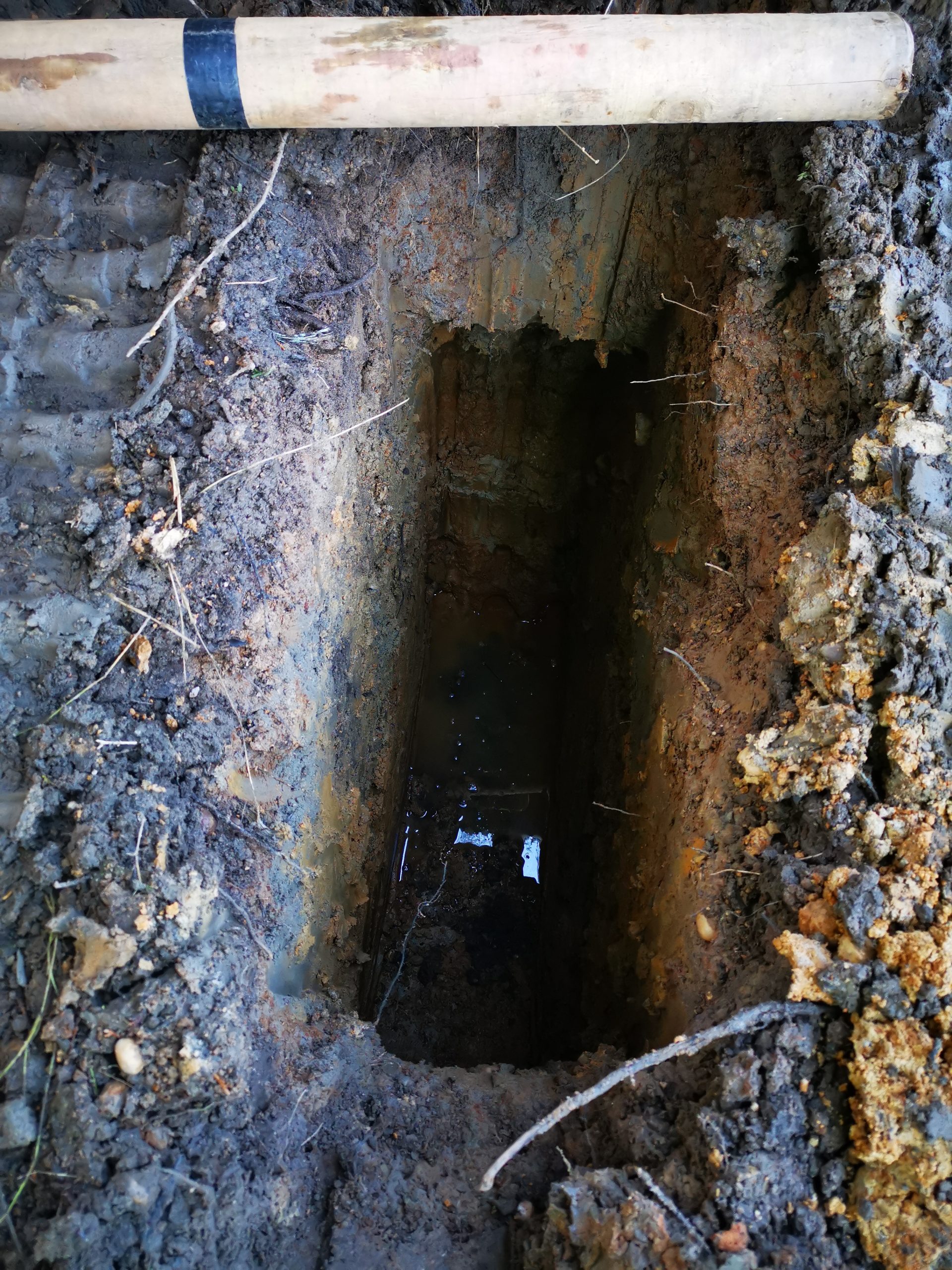
What we did. On 8 February 2020, in dry weather, we dug three trial pits (A, B and C) across the site, each 350 mm wide, 1,000 mm long and 1.5 m deep. We set out to carry out surface water percolation tests in line with BRE 365 and BS 6297. The BRE 365 method uses three timed fills per pit, measuring the fall from 75% to 25% of the effective depth.
What we found.
- Pit A: groundwater came into the pit, rising to 1.3 m below ground level.
- Pit C: groundwater came in at 1.5 m.
- Pit B: the water didn’t fall the 25% needed to start the timed test while we were on site.
Testing was abandoned in all three pits.
What it meant. Soakaways weren’t a suitable way to discharge surface water from this site, and our report ruled out discharging foul effluent to ground as well. The drainage design moved on to the next options: a local watercourse or the public sewer.
The lesson. Groundwater can rule a site out before the infiltration rate is even measured. A soakaway base has to sit at least 1 m above the highest groundwater level, and with water at 1.3 to 1.5 m that clearance isn’t possible. Testing in winter, as here, shows the ground at its wettest, which is the case the drainage has to work in.
Need a percolation test for your own site? See how we test and report.