
DRAINAGE DESIGN
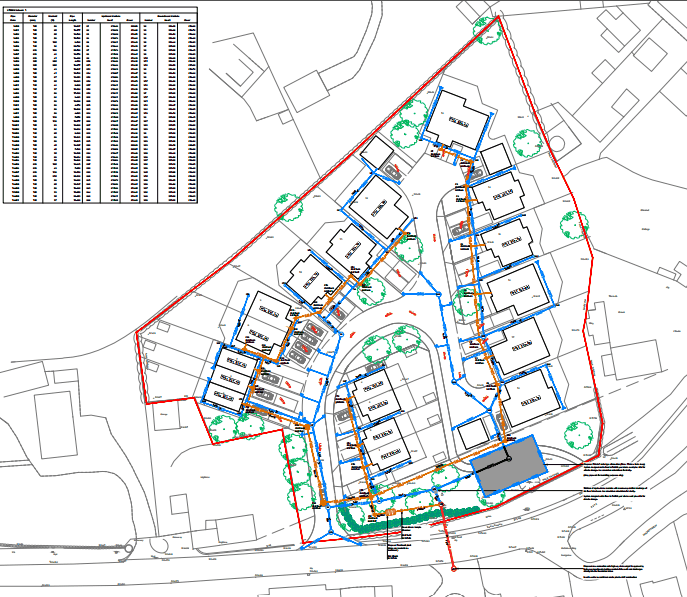
A surface water drainage strategy (sustainable drainage, or SuDS) is now expected at planning on developments of almost any size, whether you are a developer on a new build site, an architect working up a scheme, or a self builder with a single plot. It sets out how run-off will be managed on the site, reducing the rate it leaves, through infiltration where the ground allows it and storage where it does not. We work with a local engineering practice so the testing and the design come from one place.
What we can help with
Private drainage design
Designed from planning through to construction issue.
Adoptable drainage design
Designed for S104 approval and taken through to construction issue.
Maintenance strategies
Drainage maintenance strategies prepared to support planning applications.
Flood risk assessments
Required for developments over one hectare in flood zone 1, and for any development in flood zones 2 and 3.
The SuDS hierarchy, and why testing comes first
The hierarchy is an order of preference: infiltrate into the ground if you can; if you cannot, discharge to a watercourse; and only then to a sewer. Planning authorities expect you to work down that list in order and to show your evidence for ruling each option out.
That is why a BRE365 percolation test usually comes first. Until somebody has measured the infiltration rate, there is no evidence either to design a soakaway or to justify skipping one, and a strategy without that evidence tends to come back with questions attached.
HOW IT FITS TOGETHER
From test to approved strategy
1
Site testing
Percolation and, where needed, foul infiltration testing carried out on site.
2
Options appraised
The results are worked down the SuDS hierarchy to establish what the site can actually support.
3
Strategy prepared
The drainage strategy is drawn up with the engineering practice we work alongside.
4
Through to construction
Design taken through approval to construction issue, including S104 where the scheme is to be adopted.
What a strategy typically covers
- Existing and proposed run-off rates for the site
- The infiltration evidence, or the reasoning where infiltration is ruled out
- Attenuation and storage where discharge has to be restricted
- Drainage layout and levels through to construction issue
- A maintenance strategy for the drainage features proposed
Get a quote
Tell us the site postcode and roughly what is proposed, and we can advise on whether you need testing, a full strategy, or both.